Notice: Function _load_textdomain_just_in_time was called incorrectly. Translation loading for the custom-registration-form-builder-with-submission-manager domain was triggered too early. This is usually an indicator for some code in the plugin or theme running too early. Translations should be loaded at the init action or later. Please see Debugging in WordPress for more information. (This message was added in version 6.7.0.) in /home/romaed443/staging/staging.roma.education/wp-includes/functions.php on line 6131
Notice: Function _load_textdomain_just_in_time was called incorrectly. Translation loading for the remove_dashboard_access domain was triggered too early. This is usually an indicator for some code in the plugin or theme running too early. Translations should be loaded at the init action or later. Please see Debugging in WordPress for more information. (This message was added in version 6.7.0.) in /home/romaed443/staging/staging.roma.education/wp-includes/functions.php on line 6131 Staging Roma.education
Remembering the Chains, Building the Future | Roma Slavery Abolition Day – REF Romania
Posted on February 20, 2025 by admin1
Today (February 20th), as our Romanian colleagues celebrate the Abolition of Roma Slavery, a profound act of remembrance echoes across our borderless nation. We should all reflect on the enduring significance of understanding Roma history. This day, marking the end of nearly 500 years of enslavement, represents not just a historical milestone, but a watershed moment in the ongoing, often arduous, pursuit of equality for our Roma communities. This journey, etched with both immense hardship and inspiring resilience, continues to shape our present and future.
In an era where far-right ideologies are disturbingly gaining momentum, a deep understanding of our shared past is more crucial than ever. History is not merely a chronicle of events. It is a powerful force that molds our collective identity, informs our present actions, and guides the path we forge for the future. By learning about the struggles and triumphs of our ancestors, particularly the Roma community’s experience with slavery in Romania, we can build a stronger, more resilient, and just society for all.
Education stands as the cornerstone of this resilience. It empowers individuals with knowledge, fosters critical thinking, and promotes understanding and tolerance – vital antidotes to prejudice and discrimination. For the Roma community, education is more than just learning. It is a means to preserve a rich and vibrant cultural heritage, challenge deeply ingrained stereotypes, and effectively advocate for fundamental rights. It’s a tool for self-determination and empowerment.
By educating ourselves and future generations about the brutal reality of Roma slavery in Romania and our community’s ongoing fight for equality, we ensure that the injustices of the past are not forgotten, nor repeated. This vital awareness helps us actively combat the resurgence of discriminatory ideologies and practices that threaten the progress made. It allows us to dismantle the systemic barriers that still impede our Roma community’s full participation in society.
Let us honor the legacy of those who bravely fought for freedom by committing to education and unity. Let us amplify Roma voices and stories. Together, we can build a future where every member of the Roma community can thrive, free from the shackles of prejudice and the oppression that stems from ignorance. Let this day not just be a celebration, but a call to action – a call to build a truly equitable future for all.
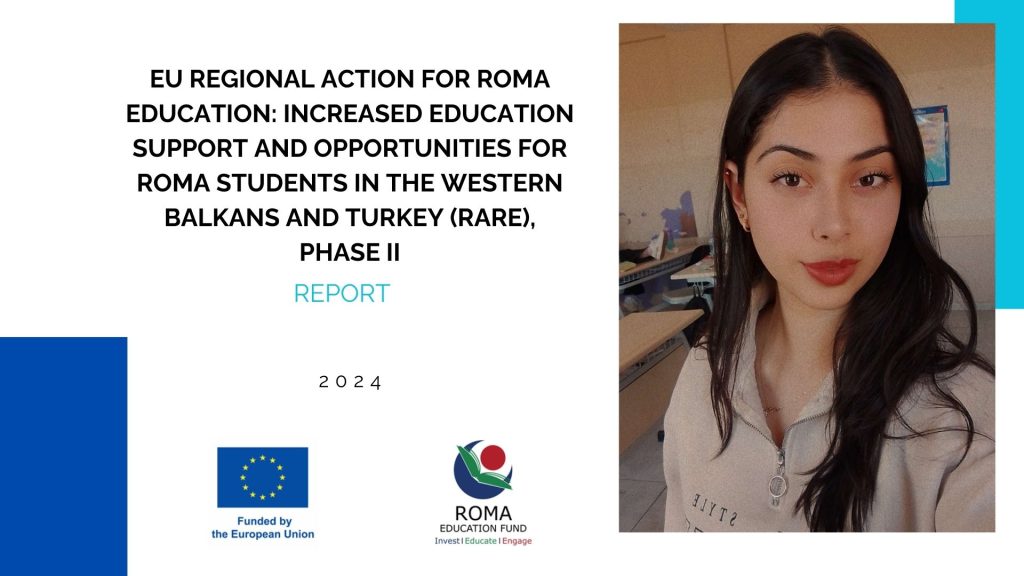
2024 Report | Eu Regional Action for Roma education: Increased Education support and Opportunities for Roma Students in the Western Balkans And Turkey (Rare), Phase II
Fundația Roma Education Fund Romania cu sediul în strada Lt. Sachelarie Visarion nr. 63, etaj 1, sector 2, București, Telefon 021/2000600, E-mail office@roma.education, anunță lansarea procedurii de selecție consultanți individuali, în scopul implementării proiectului “One-stop-shop” Centre for vulnerable migrants from Ukraine, Bucharest”.
Contracting Authority: Roma Education Foundation Address: Majke Jevrosime 51, Belgrade (Stari Grad), Serbia Contact Person: Svjetlana Mandrino Email: rareproject@roma.education
Contract Title: Event Organization Services for an International Conference
Contract Description:
The Roma Education Foundation, as part of the “EU Regional Action for Roma Education: Increased Education Support and Opportunities for Roma Students in the Western Balkans and Turkey (RARE), phase II” project, seeks to procure comprehensive event organization services. These services include logistics, accommodation, transport, interpretation services, and promotional materials for an international conference to be held in Belgrade, Serbia.
Funding Source:
Grant Contract no. CN 2022/439-850, financed by the European Commission. Title of the action “EU Regional Action for Roma Education: Increased Education Support and Opportunities for Roma Students in the Western Balkans and Turkey (RARE), phase II”.
Estimated Cost: €42,300, excluding VAT
Procurement Procedure: Local Open Tender
Awarding Criteria: Best Value for Money
Eligibility Criteria: To participate in this tender, tenderers must meet the following eligibility criteria:
Legal Standing: The tenderers must be legally registered and authorized to conduct business in the relevant jurisdiction. Proof of registration, such as a business license, must be provided.
Financial Stability: The tenderers must demonstrate sufficient financial resources and stability to execute the project, including the submission of financial statements for the past three years.
Experience: The tenderers must have at least 5 years of experience in event organization or a related field. Evidence of previous experience with similar-sized and complex events must be provided, including a portfolio and references.
Compliance with Regulations: The tenderers must comply with all relevant laws and regulations, including health and safety, environmental, labour, and anti-corruption laws. Any breaches of compliance will result in disqualification.
Insurance: The tenderer must possess the mandatory Travel Guarantee Insurance (Garancija putovanja) as required by Serbian legislation.
Tender Submission:
Interested tenderers should submit their tenders in accordance with the specifications and requirements outlined in the tender dossier. The tender dossier can be downloaded from the link below:
Tenders will be opened on February 24, 2025, at 2:30 PM. The opening will be held at Roma Education Foundation Headquarter based in Majke Jevrosime 51, Belgrade (Stari Grad), Serbia].
Additional Information: For any questions or additional information, please contact Ms. Svjetlana Mandrino at rareproject@roma.education.
Roma Education Fund Romania, in partnership with the “Elie Wiesel” National Institute for the Study of the Holocaust in Romania, convened a crucial debate on the alarming rise of far-right extremism.
Scholars, public institutions and civic society representatives gathered to discuss the urgent need for proactive measures to protect democratic values and social cohesion in these turbulent times.
“We initiated this debate for two reasons: to commemorate 80 years since the liberation of the Auschwitz camp and because it is our responsibility to find solutions for this turbulent social and political context. We cannot stand idly by while Romania is being infested by the far right,” stated Ciprian Necula, President of REF.
Alexandru Florian, Director of the “Elie Wiesel” National Institute for the Study of the Holocaust in Romania, emphasized, “I don’t believe that the enemies of democracy are TikTok or other social networks. The enemy of democracy is the far right. Unfortunately, we are witnessing a resurgence of the far right that hasn’t been seen in 80 years. How is it that, 80 years after the liberation of Auschwitz, the far right has mobilized so effectively, creating so many risks to democracy?”
The event featured notable speakers including Andreea Rusu, Director of Filia Center; Cristian Pîrvulescu, Dean of the Faculty of Political Science, SNSPA (the debate’s moderator); and Adina Marincea, Researcher at the National Institute for Holocaust Studies in Romania “Elie Wiesel.”
Following the Q&A session, REF Romania also officially launched the second edition of “The Sphere of Politics” Magazine, dedicated to their 2023 scientific conference, “Gheorghianism (Nicolae Gheorghe’s Doctrine) and the Foundations of the Roma Nation.”
Call for the Selection of Implementing Partner Organizations
Under the project “EU Regional Action for Roma Education: Increased Education Support and Opportunities for Roma Students in the Western Balkans and Turkey (RARE), phase II”, REF launches the following streams under the Call for Selection of Implementing Partner Organizations:
Early Childhood Development services (ECD) and primary education (PRI) – Expanding Access to Quality Early Childhood Development (ECD) and Primary School Education for Roma Children: Call for the Selection of Implementing Partner Organization inAlbania
Please read the details in the annexed documents and submit your applications until the above-mentioned deadline.
The Roma Education Fund Romania is seeking to hire an Expert in Project Implementation and Project Writing.
Posted on January 14, 2025 by admin2
Location: Roma Education Fund Romania HQ, Bucharest
Job Type – Full Time
REF Romania, a non-profit organization legally established in Romania in 2009, focuses on implementing publicly funded projects for vulnerable communities in disadvantaged areas of Romania, as well as international projects. To enhance our efforts in drafting and submitting new projects, we are looking to hire an expert in project implementation and writing to join our Programs Department team.
Responsibilities:
Coordinating and overseeing activities and programs within the Programs Department.
Contributing to the planning, implementation, and monitoring of both national and international projects.
Conducting field visits to schools, partner institutions, and Roma communities for work and monitoring purposes.
Collaborating with the project writing team to draft and submit funding proposals.
Maintaining effective communication with team members, partners, and project beneficiaries.
Preparing and managing documentation required for the implementation and reporting of activities.
Ensuring compliance with project timelines, budgets, and quality standards.
Providing regular updates and reports to senior management on project progress and outcomes.
Identifying and addressing any challenges or risks associated with project implementation.
Qualifications
At least 5 years of experience in managing and implementing educational and/or social projects for vulnerable communities at the national and/or international level.
At least 1 year of experience in writing educational and/or social projects at the national and/or international level.
Mandatory Education – University degree (postgraduate studies are an advantage).
Knowledge and Skills:
Fluency in written and spoken English language and Romanian language;
Proficient level of computer literacy (Microsoft Word, Excel, Power Point, Zoom, etc.);
Advantages:
Studies and experience in the pedagogical field.
Experience working with vulnerable groups, especially Roma communities.
Key Competencies:
Flexibility and adaptability.
Excellent organizational skills.
Ability to work under pressure and meet deadlines.
Capacity to work effectively in a team.
Attention to detail.
Openness to learning and continuous improvement.
Awareness of contemporary trends, approaches, and methods in education.
We Offer:
A competitive salary, commensurate with the candidate’s experience and skills.
A dynamic working environment alongside a professional and dedicated team.
Opportunities for professional development.
The chance to directly contribute to enhancing the resilience of vulnerable communities.
How to Apply:
Send an updated CV along with a Cover Letter (max. 1 page) to aflorea@roma.education by January 31, 2025, mentioning in the email subject line: “Application Expert REF RO – Your Name.”
In your cover letter, please address the following questions:
What motivates you to work for an organization that supports Roma communities?
How does your professional experience align with the requirements of this position?
Note:
Knowledge of Romani language is considered an added value;
Individuals identifying themselves as Roma, Roma Education Fund scholarship recipients, and fulfilling the above-mentioned profile and requirements are encouraged to apply. Qualified female candidates are particularly encouraged to apply.
Important: Due to a high number of applications, unfortunately, REF is not in the position to be able to respond to every applicant individually. Please note that only short-listed candidates will be contacted for the first interview.
Armina’s Journey: A Tale of Resilience and Hope
Posted on December 30, 2024 by admin2
Armina is a Recipient of the Early Childhood Education program under the EU Regional Action for Roma Education: Increased Education Support and Opportunities for Roma Students in the Western Balkans and Turkey (RARE), phase II Project, funded by the European Commission through the Directorate-General for Neighbourhood and Enlargement Negotiations and implemented by REF Romania and REF Serbia
Armina Biberovic, a bright and resilient child, was born on November 27, 2018, in the bustling city of Tuzla, Bosnia and Herzegovina. Her life, along with that of her family, has been marked by significant challenges and upheavals.
Armina lives with her mother, a determined 29-year-old woman, and her five siblings: four sisters aged 2, 3, 10, and 12, and one brother aged 8. Until recently, they resided in the Roma community of Krojcica Tuzla, a place they had called home since Armina’s birth. However, their lives were turned upside down when their father forced them out of their home. They found temporary refuge in the Roma community of Miladije Tuzla, staying with a cousin who has generously offered them shelter.
Both Krojcica and Miladije are diverse Roma communities in Tuzla. Krojcica is home to approximately 80 families, while Miladije houses around 20. Despite the hardships, Armina’s mother is unwavering in her commitment to her children’s education. Armina, now in the first grade at the Public Institution Primary School “Kreka” Tuzla, is a diligent student who loves learning. Her older siblings, who are also dedicated students, serve as positive role models for her.
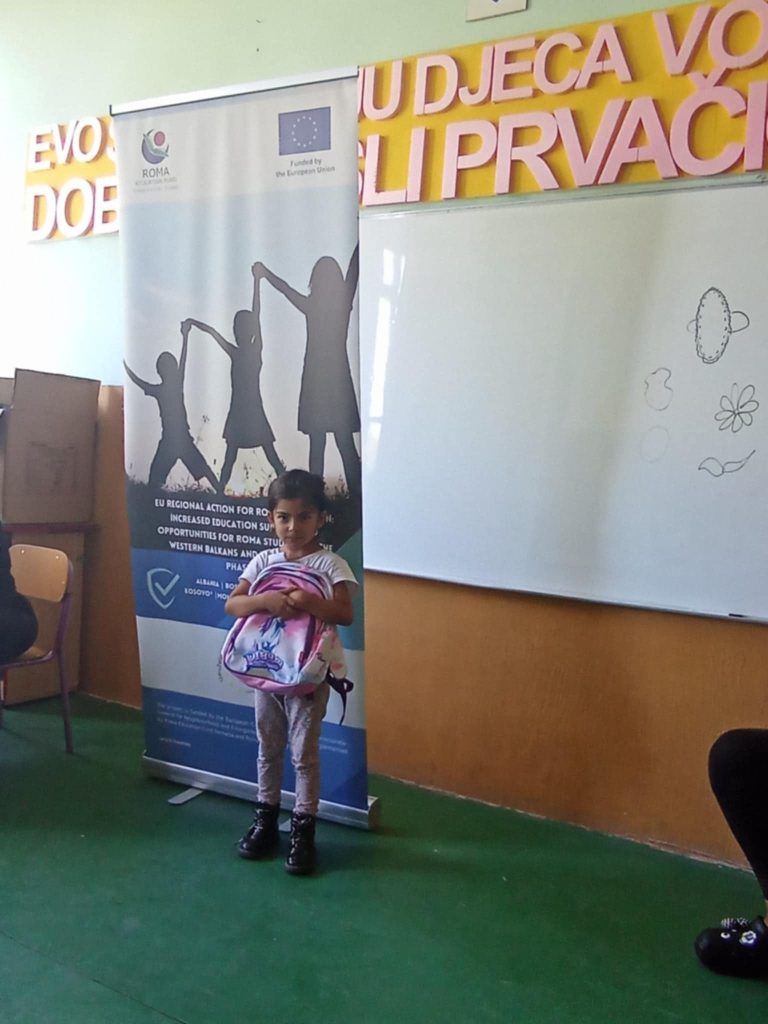
The family has been supported by the Association of Roma “Euro Rom” Tuzla, a grantee of the RARE project. They provided Armina and her brother Armin with school supplies and educational workshops. These initiatives have been crucial in preparing them for school and supporting their academic journey. Armina’s mother is determined to ensure that all her children receive a good education, hoping it will offer them opportunities she never had.
Armina’s aspirations are simple yet profound. She dreams of a stable home where her family can be warm, have enough food, and study without worries. She wishes to complete her education and support her mother, who has sacrificed so much for them. The support from the project team and the community has been a lifeline, offering hope and a sense of belonging.
Armina’s story is one of hope, resilience, and the pursuit of a better future. With the love and determination of her family and the kindness of those who support them, they can overcome many obstacles.
During the first phase, education services were provided across seven countries (Albania, Bosnia and Herzegovina, Kosovo*, Montenegro, North Macedonia, Serbia, and Turkey), engaging over 4,500 Roma children from various educational levels in educational activities.
The current phase aims to sustain and expand the achievements of the initial project, while also establishing a solid foundation for the inclusion and participation of children in education.
The project aims to bridge the gap between Roma and non-Roma in terms of participation and completion of quality education, enhance the transition of Roma students from education to employment, and foster lasting systemic change and de-segregation within education systems in the enlargement region.
Specific objectives include:
Enhancing educational outcomes at all levels, with a particular emphasis on preventing school drop-out and addressing the significant disparity between male and female education levels, thereby promoting gender inclusion.
Facilitating the transition of Roma students from education to employment, with a focus on narrowing the gender gap in education levels.
The project incorporates a gender perspective, aiming to provide educational access to Roma girls and women, thereby promoting gender equality and empowering them. The lack of access to educational services, discrimination in schools and educational institutions, and prevailing negative attitudes towards women significantly hinder Roma girls and women from accessing education. These barriers have a profound and lasting negative impact on their lives.
During the first year of implementation, as part of the Early Childhood Education/ECD Services at the project level, REF has supported at least 585 children aged 4-6 in accessing quality Early Childhood Development (ECD) services and opportunities for outdoor activities and learning. The distribution of supported children is as follows: Albania – 60, Bosnia and Herzegovina – 63, Kosovo* – 60, North Macedonia – 85, Montenegro – 122, Serbia – 159, and Turkey – 40.
Approximately 550 parents directly benefited from support facilitating enrolment in pre-primary and primary education institutions, as well as engagement in parenting programs and advocacy initiatives.
A total of 76 workshops were implemented for parents on various topics, including good parenting, digital skills, discrimination, and anti-gypsyism.
More than 40 outdoor activities were conducted for children.
Concerning the Call for Selection of Implementing Partner Organization – Montenegro on education levels – ECD and Primary education (ECD and PRI), Secondary Education (SEC), Tertiary Education (TER), REF publishes the answers to the questions received on the above-mentioned call
QUESTION
Considering that our organization plans to apply for the RARE project call, we would like to inquire about the following: given that the target population addressed by the project includes even a greater number than the scope planned by the project, and we will be able to include more beneficiaries than initially planned, we are interested to know whether the 33 ECD beneficiaries and 45 school-aged beneficiaries represent the scope planned for the entire country or per project intervention. Furthermore, are the available funds of EUR 33,030 for ECD and EUR 14,100 for PRI available per project intervention for each applicant, or are they allocated collectively for all applicants?
ANSWER
The question above has come from a potential applicant from Montenegro. Valuing transparency, below we have provided detailed answers to the questions:
Scope of Beneficiaries:
The project intervention in Montenegro under ECD and PRI components will encompass two distinct project scopes (indicated in the call as academic years). It involves supporting at least 33 ECD-aged beneficiaries and 45 PRI-aged beneficiaries within one project year, totaling 66 and 90 children, respectively, over the entire project duration, which ends on 31 August 2026 as noted in the call. These specified targets represent the minimum number of beneficiaries set for Montenegro under the project. However, it is permissible to include additional beneficiaries, provided this is planned and budgeted accordingly.
Both, Secondary (SEC) and Tertiary (TER) levels of education are targeted with a minimum of 10 beneficiaries for each educational level annually, 20 cumulative per project per level.
Allocation of Funds:
The allocated funds for the project intervention under the published call (covering ECD and PRI) will be awarded to one implementing partner organization. The maximum budget is 33,030.00 EUR per project year, amounting to a total of 66,060.00 EUR for the entire project duration.
Available funds for the Secondary (SEC) education level project are 14,100 EUR per academic year, totaling to 28,200EUR for the project duration.
As for Tertiary (TER) level of education, the available funds are 11,850EUR per project year, respectively, and total amount of 23, 700 EUR for both years. These yearly allocations are intended to cover activities planned for these levels until 31 August 2025 for the first project year, i.e. 31 August 2026 for the entire project.
If an organization applies for only one educational level, it must plan and budget activities exclusively for that level, and both years. However, if an organization applies for multiple levels (e.g., SEC and TER), it can combine certain activities across levels (and across activities within a level) to include more beneficiaries while distributing the budget between the two levels. For example:
A planned employability training activity involving both secondary and tertiary level beneficiaries could be conducted over two days with different agendas for each day. One day can be budgeted under the SEC component, while the other can be allocated to the TER component. Both days can involve secondary and tertiary beneficiaries, and not limited to the minimum number of beneficiaries.
It is important to emphasize that each of the three project scopes (ECD/Primary, Secondary, and Tertiary) should be planned and budgeted separately, adhering to the minimum beneficiary targets outlined in the Call.
Application deadline: January 22, 2025
Applications have to be submitted at: rareproposals@romaeducationfund.org
Stay connected
Subscribe to our newsletter
Get the latest Roma Education Fund news, stories and announcements in your inbox
An international financial institution that provides loans and grants to the governments of low- and middle-income countries for the purpose of pursuing capital projects.